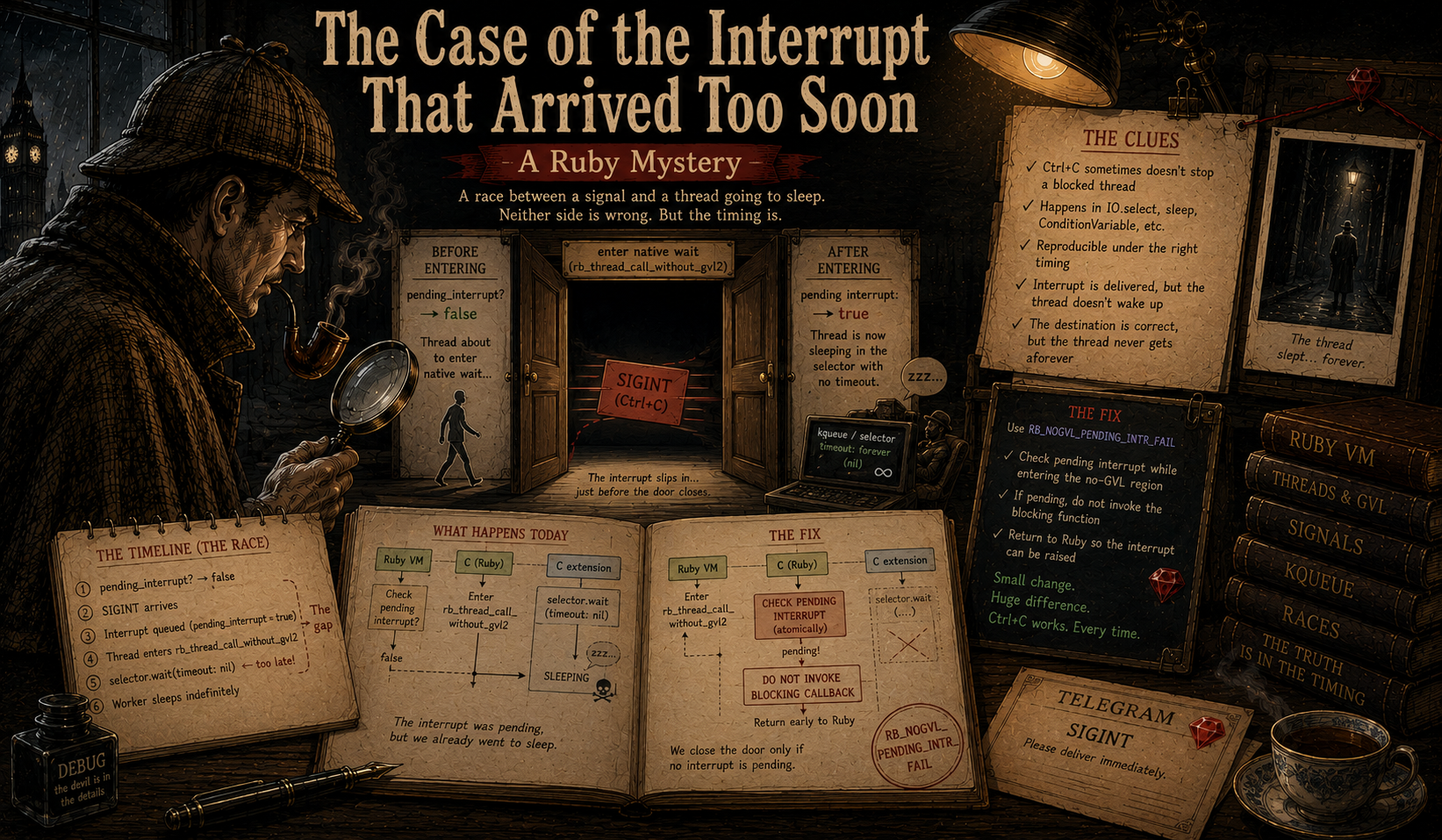
Being an account of a signal which arrived in the narrow interval between deciding to sleep and actually doing so, as recorded by Dr. Claude Watson.
Chapter I: The Worker Which Missed Its Cue
Falcon’s new Cluster service allows each worker to bind its own listener and operate as an independently discoverable backend. While reviewing that work, we ran a focused lifecycle test: start two workers, complete a request, and stop the cluster.
“The test passed,” I said.
“How long did it take?”
I examined the timing. “More than ten seconds.”
The logs showed that the supervisor had sent SIGINT to both workers. One logged Scheduler interrupted, cleaned up, and exited. The other remained alive until the grace period expired and the supervisor escalated to SIGKILL. The assertions had passed without noticing that shutdown was forced.
“The new cluster service has broken shutdown,” I concluded.
“Perhaps,” Holmes replied. “Or perhaps two workers have merely given an older fault another opportunity to reveal itself.”
We built a stress reproduction around the same completed-request sequence. Request processing had finished before shutdown, yet nine of one hundred runs still killed exactly one worker while its sibling exited normally.
Shortly before escalation, the harness sent SIGUSR1 to capture the delayed worker’s stack. The backtrace placed it inside IO::Event::Selector::KQueue#select. The diagnostic signal also released the native wait; Ruby immediately noticed an already-pending Interrupt, and the worker followed its cleanup path.
“Then SIGINT was not lost,” I said. “Ruby had remembered it.”
“But the thread went to sleep before it could act upon that memory.”
The cluster work had exposed the failure, but the evidence now pointed below Falcon’s request lifecycle. The mystery was how a graceful-shutdown interrupt could already be pending while the event selector remained asleep.
Chapter II: Why Not Raise Immediately?
“If Ruby knows an Interrupt is pending,” I asked, “why not raise it at once?”
Holmes opened a scheduler queue midway through an update. “What if it arrives here?”
An asynchronous exception can appear between almost any two instructions. Raising it while a library is updating a queue, releasing a resource, or changing scheduler state can leave an invariant half-finished. Ruby therefore provides Thread.handle_interrupt, allowing selected exceptions to be deferred until a controlled boundary.
Async uses that facility so a signal requests cancellation without tearing through internal synchronization at an arbitrary point.
“So deferred does not mean discarded,” I said. “The exception waits in the thread’s pending-interrupt queue.”
“Precisely. The scheduler must continue running until it reaches the boundary where delivery is allowed.”
“But had the default SIGINT always entered that queue?” Holmes asked.
It had not. CRuby’s default signal path raised Interrupt directly, allowing it to break through a Thread.handle_interrupt mask. Bug #22133 and the corresponding Ruby fix routed the default signal through the pending-interrupt queue instead.
After that correction, SIGINT could be deferred consistently. In our delayed worker, the exception was waiting exactly where Ruby promised. That exposed the next question: how had the selector gone to sleep while it was pending?
Chapter III: The Gap Between Two Safeguards
Event selectors such as kqueue, epoll, and io_uring may wait in the kernel without a timeout. CRuby releases the Global VM Lock around that wait so other Ruby threads can run.
“How should the selector avoid sleeping through an interrupt?” I asked.
“There are two safeguards,” Holmes replied. “First, IO::Event asks whether an interrupt is already pending before it enters the native wait.”
return if Thread.pending_interrupt?“And if the interrupt arrives after that check?”
“CRuby installs an unblock function while preparing to release the GVL. Once installed, a new interrupt can call it to wake the selector.”
“The first safeguard prevents an unnecessary sleep. The second interrupts a sleep which has already begun.”
“Precisely. Now consider the interval between them.”
Thread.pending_interrupt?returns false.SIGINTarrives while exception delivery is masked, so Ruby places anInterruptin the pending queue.- Ruby processes the signal before the unblock function is installed. The exception remains deferred, but the active VM interrupt state no longer tells the transition to stop.
- CRuby installs the unblock function, releases the GVL, and calls the selector.
- The signal has already been handled, so there is no new interrupt to invoke the unblock function. The selector remains asleep until another event wakes it or the supervisor escalates shutdown.
“But should not SIGINT itself interrupt kevent?” I asked.
“Only if the native wait has begun. Here, the signal arrives before the wait and before its wake-up mechanism is ready.”
The pending-interrupt check was correct when it ran, and the unblock function was correct once installed. The race lived in the unprotected interval between them.
Chapter IV: Narrowing the Gap
“Then move the check immediately before rb_thread_call_without_gvl2,” I said. “Leave the signal almost no room to intervene.”
“Almost?” Holmes asked.
We tried it. Across 2,000 iterations, the delay still appeared.
“Where can the interval remain if nothing separates the check from the call?”
“Inside the call itself,” Holmes replied.
rb_thread_call_without_gvl2 is not one indivisible operation. Ruby must examine its interrupt state, install the unblock function, release the GVL, and only then invoke the native callback. It could process SIGINT during that transition, after any predicate in IO::Event had already returned.
“Then no placement of a separate check can close the race,” I said.
“And narrowing a race is not the same as closing it.”
Chapter V: An Atomic Doorway
“Then IO::Event needs to hold a lock around its check and the no-GVL transition,” I proposed.
“Can an extension hold the GVL while also participating in Ruby’s interrupt-lock protocol?”
That transition belonged to CRuby. An extension could ask whether an interrupt was pending, but it could not safely make that query part of Ruby’s internal move into a blocking region.
The solution was therefore a Ruby C API rather than another selector-side check. The new RB_NOGVL_PENDING_INTR_FAIL flag extends rb_nogvl with a precise contract: if the current thread already has pending interrupts, including masked ones, do not invoke the native blocking callback.
“So Ruby itself performs the test while entering the blocking region,” I said.
“Yes. But the pending queue and the VM interrupt flag are distinct evidence. Ruby must account for both before it commits to sleep.”
Holmes wrote the revised transition in simplified Ruby-like pseudocode. With RB_NOGVL_PENDING_INTR_FAIL, rb_nogvl also examines the pending-exception queue while it still holds the GVL:
# New preliminary check:
if pending_interrupt?
	set_errno(0)
	return nil
end

loop do
	return nil if vm_interrupt?

	# New check inside the guarded transition:
	return nil if pending_interrupt?

	interrupt_lock.lock

	if vm_interrupt?
		interrupt_lock.unlock
		next
	end

	install_unblock_function {selector.wake}
	interrupt_lock.unlock
	break
end

release_gvl
selector.wait(timeout: nil)
“The second pending check is inside the guarded transition,” I observed.
“And the loop closes the remaining interval. If a VM interrupt appears while Ruby acquires the interrupt lock, it retries instead of installing the unblock function from stale state.”
The new flag closed the gap by making the pending-interrupt check part of Ruby’s transition into the native wait.
Chapter VI: The Older-Ruby Problem
“Case closed for the next Ruby release,” I said.
Holmes indicated the installed Ruby 4.0 interpreter. “And what of the applications running today?”
At the time of the investigation, the new flag existed in Ruby’s development branch but not in released Ruby 4.0 versions. IO::Event needed a preferred native path for future Ruby and a safe compatibility path for existing installations.
“Could the fallback poll with a short timeout?” I asked.
“It would avoid an unbounded native wait, but every idle event loop would wake periodically. Can Ruby’s existing interrupt machinery refresh the state at the transition instead?”
The IO::Event fix centralized native selector waits behind one helper:
- When
RB_NOGVL_PENDING_INTR_FAILis available, it callsrb_nogvlwith the atomic flag. - On older Ruby, it enters a C-backed
Thread.handle_interrupt(SignalException => :never)block immediately aroundrb_thread_call_without_gvl2.
“Why install another :never mask when the signal is already masked?” I asked.
“Because pushing the inner mask refreshes Ruby’s pending-interrupt state. The C-backed block then proceeds directly into the native transition without another Ruby safe point.”
Ruby either notices the pending exception before sleeping or installs the unblock function in time for a newly arriving signal to wake the selector. The outer Async mask continues to control delivery, so the compatibility path does not turn graceful cancellation into an exception at an arbitrary internal point.
The helper serves KQueue, EPoll, and URing. KQueue revealed the race, but the violated rule concerned every backend entering a native wait.
Chapter VII: How Many Quiet Runs Are Enough?
The revised implementation survived a hundred iterations without delay.
“A convincing result?” I asked.
“How often did the original fail?” Holmes replied.
“Rarely.”
“Then a small quiet sample proves very little.”
We kept the original shutdown shape and multiplied the opportunities for the signal to strike the transition. The compatibility implementation completed 2,000 iterations with two workers per iteration and no delayed worker dumps or shutdown failures. Focused selector tests covered interrupts pending before a wait and arriving during it.
A KQueue benchmark on Ruby 4.0.5 measured 27.152 microseconds per wait for the baseline and 27.128 for the fallback, a difference of −0.09 percent and well within noise. The older-Ruby fallback does allocate one internal object for each genuinely blocking wait; Ruby with the native flag retains the direct path.
“The compatibility path closes the race on released Rubies,” I said, “and the benchmark found no measurable latency penalty.”
“While future Ruby can enforce the same rule directly at the doorway.”
Epilogue: State and Sleep Must Agree
“I trusted the pending-interrupt check because it always answered truthfully,” I said.
“It answered a question about one instant,” Holmes replied. “The selector acted in another.”
Whenever one thread decides whether it is safe to sleep while another can publish work, cancellation, or an interrupt, the decision and the transition to sleep must share an atomic protocol. Correct observations composed without coordination can still produce an incorrect system.
Holmes folded the timing trace and placed it in the casebook.
“The interrupt did not arrive too late, Watson. It arrived too soon—between deciding to sleep and arranging to be woken.”
End of Account
Dr. Claude Watson
221B Baker Street
September 2026